

While there are some similarities between Renewable Energy Certificates (RECs) and carbon credits, there are some really important differences!
RECs vs Carbon Credits: Side-by-Side Comparison
RECs Carbon Credits Unit of measurement MWh tCO2e What one unit represents 1 MWh of renewable electricity generated 1 tonne of CO2e avoided or removed Purpose Reduce GHG emissions from electricity consumption and promote clean energy Offset GHG emissions and balance out unavoidable emissions Emissions scope covered Scope 2 only Scope 1, 2 and 3 Eligible sources Renewable electricity only — solar, wind, hydro, geothermal, biomass Any project that lowers, removes or avoids emissions — forestry, landfill gas, livestock biogas, industrial gas Location and time matching Same country, and roughly the same time period as the electricity consumed Country of origin and time period do not need to match your emissions Standards I-REC, Guarantees of Origin (GO), plus multiple North American standards Gold Standard, Verra VCS, Global Carbon Council Type of climate claim No additional emissions were generated by the electricity consumed — counted as a reduction Fewer emissions than a business-as-usual baseline — used as an offset Recognition in reporting Recognised by the majority of carbon accounting and reporting initiatives Recognised by several carbon accounting and reporting initiatives
Both instruments trade on voluntary markets, and both have compliance markets in certain countries. A generator may claim either a REC or a carbon credit from a given MWh — never both. Overview of RECs
| RECs | Carbon Credits | |
|---|---|---|
| Unit of measurement | MWh | tCO2e |
| What one unit represents | 1 MWh of renewable electricity generated | 1 tonne of CO2e avoided or removed |
| Purpose | Reduce GHG emissions from electricity consumption and promote clean energy | Offset GHG emissions and balance out unavoidable emissions |
| Emissions scope covered | Scope 2 only | Scope 1, 2 and 3 |
| Eligible sources | Renewable electricity only — solar, wind, hydro, geothermal, biomass | Any project that lowers, removes or avoids emissions — forestry, landfill gas, livestock biogas, industrial gas |
| Location and time matching | Same country, and roughly the same time period as the electricity consumed | Country of origin and time period do not need to match your emissions |
| Standards | I-REC, Guarantees of Origin (GO), plus multiple North American standards | Gold Standard, Verra VCS, Global Carbon Council |
| Type of climate claim | No additional emissions were generated by the electricity consumed — counted as a reduction | Fewer emissions than a business-as-usual baseline — used as an offset |
| Recognition in reporting | Recognised by the majority of carbon accounting and reporting initiatives | Recognised by several carbon accounting and reporting initiatives |
RECs are the environmental attributes of electricity generated from renewable energy (RE) sources. RECs allow electricity consumers to virtually choose to source electricity from RE power plants. RE power plants generate electricity without creating Greenhouse Gas (GHG) emissions, so switching to RE allows consumers to reduce their GHG emissions.
Overview of Carbon Credits
A Carbon Credit or Carbon Offset is a claim that a project has reduced GHG emissions or GHG in the atmosphere, by one tonne of carbon dioxide equivalent (tCO2e). Carbon Credits enable companies to offset their GHG emissions to achieve “net zero”.
Key Differences
The following overview is intended as a general introduction to the differences between these two broad categories of environmental commodities.
Consider these five key differences between RECs and carbon credits:
1) Different Purposes
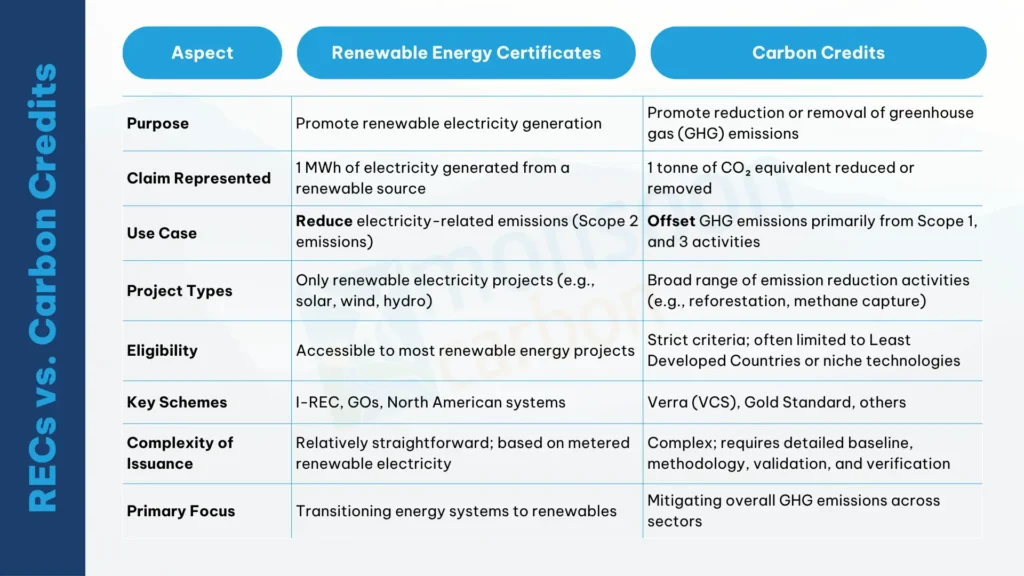
Firstly, the two environmental commodities exist for different reasons. RECs are intended to promote the production of renewable energy, while carbon credits are intended to promote the reduction of greenhouse gas (GHG) emissions.
2) Different Claims
The two environmental commodities represent different claims. RECs are used to certify that power has been generated from a renewable source, while carbon credits are used to claim that GHG emissions by a company are offset or have been removed by some other activity.
As a result, each REC represents a MWh of renewable electricity, while each carbon credit represents an amount of GHG equivalent to one tonne of carbon dioxide that has been avoided or removed from the atmosphere.
3) RECs are Exclusively for Renewable Energy
RECs can only be issued for the production of renewable electricity. However, carbon credits can come from many different emission reduction activities: this might include the preservation of forests, the restoration of an ecosystem, or the capture of methane from an industrial activity, all of which can be quantified by a scientific methodology that has been subject to rigorous scrutiny and review.
4) RECs are Accessible to Most Renewable Energy Projects
RECs can be issued for most renewable energy projects. However, carbon credits have very strict eligibility rules that mean that very few new renewable energy projects will be able to register to issue carbon credits.
In practice, the only renewable energy projects that can now be registered on a carbon standard are those that are located in Least Developed Countries, or in countries where the technology is uncommon, or where the project concerns a technology that has been deemed to be very early in its development and therefore deserves the incentives that carbon credits provide.
5) Different Standards and Different Issuers
RECs are issued under standards such as Guarantees of Origin (GOs) in Europe, or International Renewable Energy Certificates (I-RECs). North America has its own complex system of multiple different standards.
Carbon credits are issued by standards such as Gold Standard (GS) or Verra’s Verified Carbon Standard (VCS). The rules and procedures are different between these standards. Because the reduction of GHG emissions is a complex claim, the process for registering an emissions reduction project and verifying the issuance of carbon credits is much, much more complicated and resource intensive that the process for RECs.
Other Points of Note
This overview wouldn’t be complete without a few important concluding notes:
No Double Claiming!
It is possible that a renewable energy project could be registered for both RECs and carbon credits. However, it is not possible for a producer of renewable energy to claim both a REC and a carbon credit from the same unit of renewable energy. The generator can claim the REC, or the carbon credit (if they’re registered on a carbon standard), but never both. This is strictly prohibited and closely monitored.
A Limited Window of Opportunity
Carbon credits are intended as a tool to direct finance to technologies and activities that require medium-term financial support. As a result, the rules for carbon credits must evolve. As certain practices become common, such as the generation of renewable energy in high-income countries, they lose eligibility to register for the financial support of carbon credits.
RECs has a slightly larger window of opportunity. Almost all renewable energy can register to issue RECs, although there are some rules that limit the ability for companies to purchase RECs from older renewable energy power plants.
Please note that you can read more about carbon credits here.
Frequently Asked Questions
Yes. They address different things. RECs cover Scope 2 emissions from purchased electricity, while carbon credits offset Scope 1, 2 and 3 emissions. Most companies reduce their electricity emissions with RECs first, then use carbon credits for emissions they cannot avoid.
Yes. Under the GHG Protocol market-based method, redeeming RECs for the electricity you consume lets you report zero emissions for that electricity. The RECs must come from the same market and roughly the same time period as your consumption.
A project can be registered for both, but it cannot claim a REC and a carbon credit from the same MWh. Double claiming is strictly prohibited and closely monitored. The generator chooses one or the other for each unit of electricity.
RECs. RE100 requires Energy Attribute Certificates to be cancelled to support a renewable electricity claim in markets where they are in common use. Carbon credits cannot be used to meet an RE100 target.
Carbon credit eligibility rules exclude activities that have become common practice. Today only renewable projects in Least Developed Countries, or using technology that is uncommon or very early in its development, can register under a carbon standard.
Turn climate ambition into credible action!
Whether you’re navigating RECs or carbon credits, Monsoon Carbon helps you unlock the full value of your renewable energy and emissions reduction efforts. We support companies committed to decarbonization with trusted access to high-quality certificates across 30+ emerging markets, guiding energy buyers, project developers, and corporates through every step of the journey.
Take climate action that’s verifiable, scalable, and aligned with your goals.
👉 Get in touch today for a free consultation with our expert team!


 WhatsApp
 Zalo
Zalo
