

Understanding emission sources and categorizing them by “scope” is the first step for businesses to develop an effective reduction strategy. This article will provide a detailed and easy-to-understand explanation of Scope 1, 2, and 3 emissions, along with real-world examples relevant to businesses.
Why are there 3 Scopes of Emissions?
To effectively reduce emissions, businesses need a clear understanding of the origin of their carbon footprint. This is where the concept of emissions scopes comes in.
The Greenhouse Gas Protocol, developed by World Resources Institute and World Business Council for Sustainable Development, categorizes emissions into three main scopes based on their origin. This protocol enables companies, corporations and governments to measure and manage the amount of their emissions, from direct operations to the broader “value chain”.
Let’s dive into each type of emission to learn more.
Scope 1,2,3 Emissions: Explained and Examples
1. What are Scope 1 Emissions?
These are direct emissions generated by a company’s production and business activities, from sources that the company owns or controls. Typical examples include:
Fossil Fuel Combustion:
- Using coal, natural gas, or fuel oil to operate boilers, production machinery, and transport vehicles.
- Product testing, operating backup generators.
Industrial Processes:
- Chemical reactions, metal smelting, mechanical processing.
- Gas leaks from equipment, pipelines, storage tanks.
Other Activities: Using refrigerants in air conditioning systems; Managing solid waste and wastewater
Examples:
- Cement manufacturing plant: Direct CO2 emissions from the calcination of limestone and fossil fuel combustion.
- Textile factory: Direct CO2 emissions from fuel combustion in boilers, fabric dyeing, and operating transport trucks.
2. What are Scope 2 Emissions?
These emissions are indirectly generated from the purchase of electricity, heat, or steam from external suppliers. In other words, these are emissions from the production of the energy that the company uses. Examples include:
Purchasing electricity: Using electricity supplied by fossil fuel power plants (coal, natural gas).
Purchasing steam: Using steam from energy service providers for production activities.
Purchasing heat: Using heat from energy service providers for manufacturing operations.
Examples:
- Brewery: Using electricity from the national grid during production, storage, and bottling processes.
- Food processing plant: Purchasing steam for sterilization and canning of products.
3. What are Scope 3 Emissions?
Scope 3 emissions include all indirect emissions that arise from a company’s activities but are not directly owned or controlled by the company, covering the entire supply chain (both upstream and downstream). This type of emission is the most complex and diverse.
The GHG Protocol corporate standard classifies Scope 3 emissions into 15 different categories, as shown in Figure 1. Although not all categories are relevant to every organization, these provide a structured framework to understand, measure, report and monitor Scope 3 sources of emissions across a value chain.
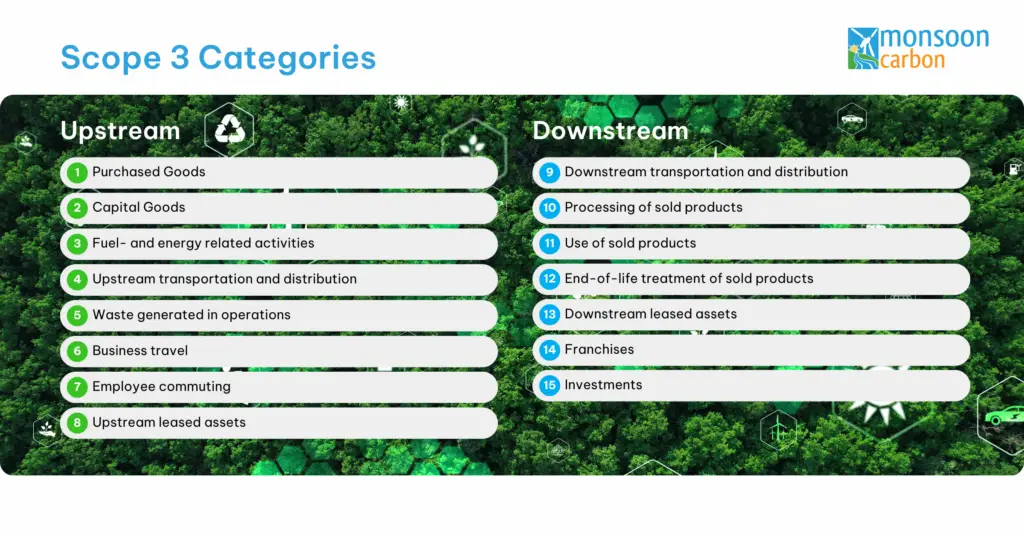
Examples:
- Smartphone Manufacturing Company: Scope 3 emissions from metal ore extraction, electronic component production, and transporting products to customers.
- Retail Fashion Company: Scope 3 emissions from purchasing raw materials, outsourcing production, processing finished products, and transporting products from suppliers to distribution warehouses.

How Easy Is It to Reduce Scope 1, 2, and 3 Emissions?
Reducing emissions across Scope 1, 2, and 3 involves various challenges and considerations, ranging from cost to practicality. While some actions are within a company’s direct control, others are more difficult to manage.
Scope 1 and 2 emissions are often easier to quantify and reduce because they stem from direct energy use and operations. For example:
- Scope 1: Companies can choose to upgrade their fleets to low or zero-emission vehicles or implement energy-efficient production processes.
- Scope 2: Businesses have the ability to control how their buildings are powered, such as by switching to renewable energy sources or improving energy efficiency.
Because these emissions are tied to direct operations, companies can more easily track and manage them by using data from energy bills and fuel consumption records.
Scope 3 emissions, on the other hand, are much more complex and challenging to manage. These emissions originate from indirect activities outside of a company’s direct control, such as those in the supply chain, product use, and end-of-life disposal. For instance:
- A soft drinks company can’t dictate how consumers will dispose of plastic bottles.
- An appliance manufacturer can’t control whether customers use energy-efficient settings on their washing machines.
Despite being difficult to control, Scope 3 emissions often represent the largest share of a company’s total carbon footprint. This makes them critical to address, even though they are challenging to quantify and reduce.
Interested in Reducing Your Company’s Emissions?
Monsoon Carbon is a trusted leader in environmental commodities across emerging markets in 30+ countries. We provide practical, effective solutions enabling your company to reduce or offset its carbon footprint.
Contact us today for dedicated support and expert guidance!


 WhatsApp
 Zalo
Zalo
